







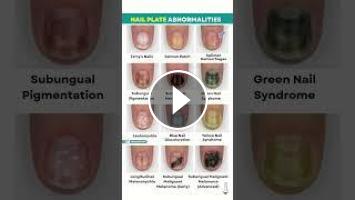
Abnormalities of the Nail Plate
1. Terry’s Nails
→ Nail plate appears diffusely white or pale with a narrow distal pink or brown band
→ Due to decreased vascularity of nail bed
→ Common associations
→ Hypoalbuminemia
→ Liver cirrhosis
→ Congestive heart failure
→ Diabetes mellitus
→ Chronic kidney disease
2. Salmon Patch (Oil Drop Sign)
→ Yellow-pink translucent patch visible beneath nail plate
→ Represents psoriatic involvement of nail bed
→ Highly specific for nail psoriasis
→ Often associated with
→ Pitting
→ Onycholysis
→ Subungual hyperkeratosis
3. Splinter Hemorrhages
→ Thin, longitudinal reddish-brown streaks under nail plate
→ Caused by rupture of nail bed capillaries
→ Seen in
→ Trauma (most common)
→ Infective endocarditis
→ Vasculitis
→ Antiphospholipid syndrome
4. Subungual Pigmentation (Low-Grade Hematoma)
→ Brownish or reddish discoloration beneath nail plate
→ Usually due to minor repeated trauma
→ Pigment does not involve nail matrix
→ Lesion grows out with nail growth
→ Important differential: melanoma
5. Subungual Hematoma
→ Dark red, maroon, or black discoloration
→ Represents acute bleeding under nail plate
→ Usually painful initially
→ Common after blunt trauma
→ Color migrates distally with nail growth
6. Green Nail Syndrome
→ Green-black discoloration of nail plate
→ Caused by Pseudomonas aeruginosa infection
→ Occurs in moist environments
→ Seen in
→ Onycholysis
→ Chronic water exposure
→ Artificial nails
7. Leukonychia
→ White spots or transverse white streaks on nail plate
→ Due to abnormal keratinization of nail matrix
→ Most commonly from minor trauma
→ Lesions move distally with nail growth
→ Not due to calcium deficiency
8. Blue Nail Discoloration
→ Diffuse bluish coloration of nail plate
→ Caused by reduced oxygenation or altered hemoglobin
→ Seen in
→ Cyanosis
→ Methemoglobinemia
→ Drug-induced (e.g., antimalarials, amiodarone)
→ Advanced systemic illness
9. Yellow Nail Syndrome
→ Yellow, thickened, slow-growing nails
→ Loss of cuticle often seen
→ Classic triad
→ Yellow nails
→ Lymphedema
→ Respiratory disease (chronic sinusitis, bronchiectasis, pleural effusion)
10. Longitudinal Melanonychia
→ Single or multiple brown-black vertical bands
→ Pigment originates from nail matrix melanocytes
→ Common causes
→ Benign melanocytic activation
→ Junctional nevus
→ Physiological (especially in darker skin types)
→ Requires differentiation from melanoma
11. Subungual Malignant Melanoma (Early)
→ Irregular pigmented band with
→ Uneven borders
→ Color variation
→ Widening proximally
→ Hutchinson sign may be present
→ High suspicion if single digit involved
→ Does not move with nail growth
12. Subungual Malignant Melanoma (Advanced)
→ Large irregular pigmented mass
→ Nail plate destruction or lifting
→ Possible ulceration or bleeding
→ Represents late presentation
→ Poor prognosis if diagnosis delayed
#nail #nailhealth #naildesign
Medical disclaimer: Medinaz Academy does not provide medical advice. The content available in our books and videos, on our website, or on our social media handles do not provide a diagnosis or other recommendation for treatment and are not a substitute for the professional judgment of a healthcare professional in diagnosis and treatment of any person or animal. We intend to provide educational information only. The determination of the need for medical services and the types of healthcare to be provided to a patient are decisions that should be made only by a physician or other licensed health care provider. Always seek the advice of a physician or other qualified healthcare provider with any questions you have regarding a medical condition.
1. Terry’s Nails
→ Nail plate appears diffusely white or pale with a narrow distal pink or brown band
→ Due to decreased vascularity of nail bed
→ Common associations
→ Hypoalbuminemia
→ Liver cirrhosis
→ Congestive heart failure
→ Diabetes mellitus
→ Chronic kidney disease
2. Salmon Patch (Oil Drop Sign)
→ Yellow-pink translucent patch visible beneath nail plate
→ Represents psoriatic involvement of nail bed
→ Highly specific for nail psoriasis
→ Often associated with
→ Pitting
→ Onycholysis
→ Subungual hyperkeratosis
3. Splinter Hemorrhages
→ Thin, longitudinal reddish-brown streaks under nail plate
→ Caused by rupture of nail bed capillaries
→ Seen in
→ Trauma (most common)
→ Infective endocarditis
→ Vasculitis
→ Antiphospholipid syndrome
4. Subungual Pigmentation (Low-Grade Hematoma)
→ Brownish or reddish discoloration beneath nail plate
→ Usually due to minor repeated trauma
→ Pigment does not involve nail matrix
→ Lesion grows out with nail growth
→ Important differential: melanoma
5. Subungual Hematoma
→ Dark red, maroon, or black discoloration
→ Represents acute bleeding under nail plate
→ Usually painful initially
→ Common after blunt trauma
→ Color migrates distally with nail growth
6. Green Nail Syndrome
→ Green-black discoloration of nail plate
→ Caused by Pseudomonas aeruginosa infection
→ Occurs in moist environments
→ Seen in
→ Onycholysis
→ Chronic water exposure
→ Artificial nails
7. Leukonychia
→ White spots or transverse white streaks on nail plate
→ Due to abnormal keratinization of nail matrix
→ Most commonly from minor trauma
→ Lesions move distally with nail growth
→ Not due to calcium deficiency
8. Blue Nail Discoloration
→ Diffuse bluish coloration of nail plate
→ Caused by reduced oxygenation or altered hemoglobin
→ Seen in
→ Cyanosis
→ Methemoglobinemia
→ Drug-induced (e.g., antimalarials, amiodarone)
→ Advanced systemic illness
9. Yellow Nail Syndrome
→ Yellow, thickened, slow-growing nails
→ Loss of cuticle often seen
→ Classic triad
→ Yellow nails
→ Lymphedema
→ Respiratory disease (chronic sinusitis, bronchiectasis, pleural effusion)
10. Longitudinal Melanonychia
→ Single or multiple brown-black vertical bands
→ Pigment originates from nail matrix melanocytes
→ Common causes
→ Benign melanocytic activation
→ Junctional nevus
→ Physiological (especially in darker skin types)
→ Requires differentiation from melanoma
11. Subungual Malignant Melanoma (Early)
→ Irregular pigmented band with
→ Uneven borders
→ Color variation
→ Widening proximally
→ Hutchinson sign may be present
→ High suspicion if single digit involved
→ Does not move with nail growth
12. Subungual Malignant Melanoma (Advanced)
→ Large irregular pigmented mass
→ Nail plate destruction or lifting
→ Possible ulceration or bleeding
→ Represents late presentation
→ Poor prognosis if diagnosis delayed
#nail #nailhealth #naildesign
Medical disclaimer: Medinaz Academy does not provide medical advice. The content available in our books and videos, on our website, or on our social media handles do not provide a diagnosis or other recommendation for treatment and are not a substitute for the professional judgment of a healthcare professional in diagnosis and treatment of any person or animal. We intend to provide educational information only. The determination of the need for medical services and the types of healthcare to be provided to a patient are decisions that should be made only by a physician or other licensed health care provider. Always seek the advice of a physician or other qualified healthcare provider with any questions you have regarding a medical condition.
- Catégories
- Ongles
Ajouter un commentaire
Up Next
Autoplay
-
00:06

???? Nail Symptoms That Reveal Hidden Diseases | Health Warning Signs You Shouldn’t Ignore! #shorts
-
00:06
Your Nails Are Warning You! 24 Nail Signs That Reveal Hidden Diseases
-
02:54
fashion nail art designs #new nail polish #gel manicure#nail style #nail video #vernis à ongle
-
00:18
Short nail for Valentine's Day/ nail art inspo/ trendy nail 2025 /best nail art
-
00:31
Stamping Plate nails ???? ???? Easy nail art at home ???? #nailart #simplenails #nails
-
07:59

15 COIFFURES FACILES POUR LES PETITES FILLES
-
04:48

Comment faire une tresse sur le côté ? Tuto coiffure simple et belle avec tresse
-
05:52

10 IDÉES COIFFURES POUR CHEVEUX CRÉPUS | Shelby Bj
-
12:24

➳ 7 idées Coiffures sur Cheveux COURTS (longueur épaules) | L.A Hairstyle Inspiration
-
07:56

Coiffure pour tous les jours cheveux mi long/long
Commentaires